Hate speech against minorities (HRC28, 2015, OS)

March 18, 2015

IMADR statement on “Hate speech against minorities” at the 28th session of the Human Rights Council. Whole text can be read below or downloaded here.

———

IMADR Oral Statement: 28th session of the Human Rights Council

Item 3: Interactive Dialogues with the Special Rapporteur on minority issues

18 March 2015

Thank you Mr. President,

We welcome the report of Ms. Rita Izsàk’s and her study on hate speech and incitement to hatred against minorities in media. The study can serve as practical guidelines for various stakeholders to take effective measures to combat hate speech in media including the internet.

We reiterate Madam Rapporteur’s emphasis on the need to take structural inequalities into account when States tackle hate speech. With this regard, we would like to highlight difficulties for people belonging to minorities to take counter measures if there is a lack of protection from incitement to hatred and racial discrimination. In such societies, minorities can be easily subject to retaliation as a result of speaking up against hate speech, which can also escalate to hate crimes. Therefore, States should not leave hate speech issues in the hands of minority communities by simply claiming that they can exercise their freedom of expression to counter hateful messages. Minority communities need special protection measures to acquire equal enjoyment of human rights.

 Moreover, it has to be reminded that minority communities are often not monolithic. Majority societies tend to categorise minority communities based on their broader status such as race, ethnicity or religion, which ignores diverse and delicate identity of each group. Such diversity of minority communities can cause difficulties to unite themselves, and take collective measures against hate speech. Therefore, as Madam Rapporteur recommended, States must involve both minority and majority communities in addressing hate speech and incitement. This is essential to create societies which do not tolerate discrimination against minorities.

While endorsing the recommendations of Madam Rapporteur, we urge States, which have not done so, to ratify the International Convention on the Elimination of All Forms of Racial Discrimination (ICERD). We also call upon the State parties putting reservation under the Article 4 to withdraw it, and adopt appropriate measures to combat hate speech in conformity with the Convention as well as its General Recommendation No. 35.

Thank you Mr. President.
Share on:

Related Content

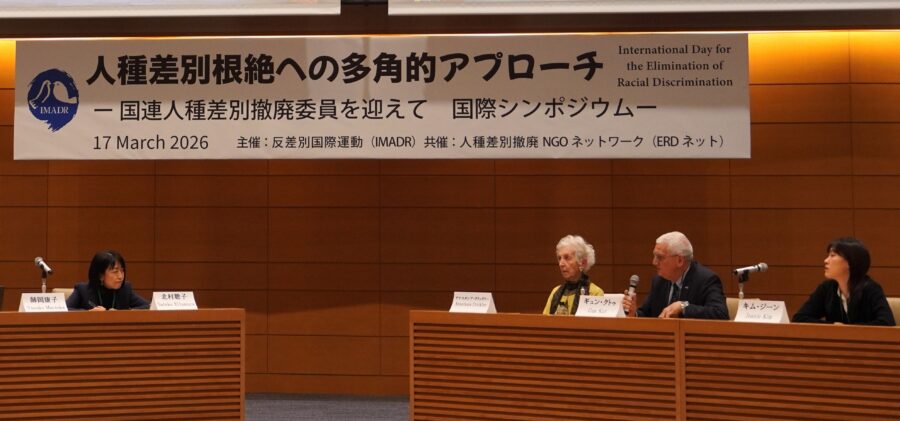
【EVENT】Multifaceted Approach to Eliminating Racial Discrimination

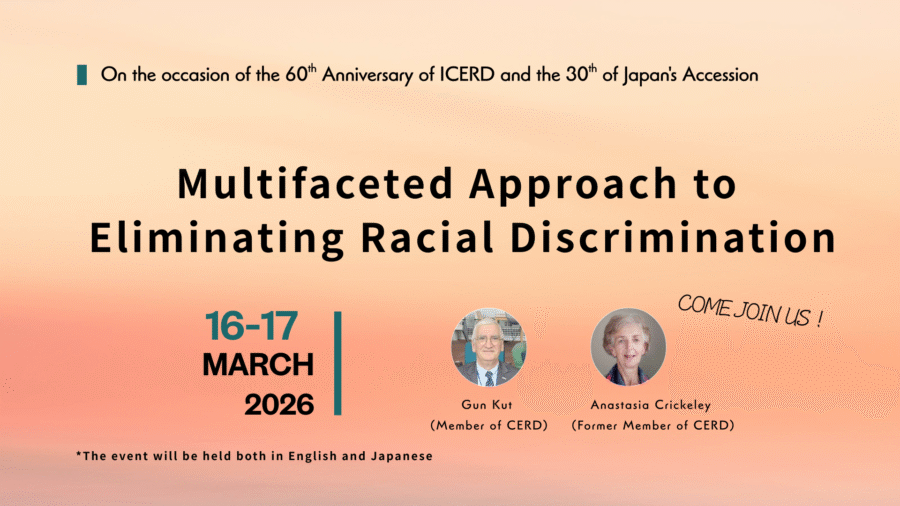
On the occasion of the 60th anniversary of the ICERD and the 30th anniversary of Japan’s accession, and welcoming the LOIPR of CERD to Japan, IMADR and partner NGOs jointly identify challenges we face in our work for the elimination of racial discrimination through the consultation with the Committee experts we invite, and make strategic plans for the next steps. It should give impacts and pressure to the Government in its preparation for its next periodic report to the Committee, to the politicians to work more on the issues of racism and discrimination and to the civil society to join us towards the elimination of racial discrimination. With Experts from […]
February 17, 2026

Joint NGO report to CERD for the preparation of LOIPR

A list of issues prior to reporting (LOIPR) for Japan, containing 59 items, was adopted by the Committee on the Elimination of Racial Discrimination (CERD) during its 116th session. IMADR and the Japan NGO Network for the Elimination of Racial Discrimination (ERD-Net) contributed to this process by submitting joint NGO reports. *You can find LOIPR issued by CERD here. ▼ Download our report: Part A (highlighting legal framework in Japan; hate speech and hate crime; racial profiling) Part B (highlighting minorities, including Buraku people, Ainu Indigenous Peoples, people in the Ryukyus and other residents in Okinawa Prefecture, women belonging to minority groups, and returnees from China and their families) Part […]
January 5, 2026

CERD 116th session summary: Burundi, Guatemala, Maldives, New Zealand, Sweden and Tunisia

From 17 November to 5 December 2025, the UN Committee on the Elimination of Racial Discrimination (CERD) held its 116th session. During the session, CERD reviewed and adopted concluding observations on the reports of Burundi, Guatemala, Maldives, New Zealand, Sweden and Tunisia. Highlights of the session included: The lists of issues prior to reporting for Japan and Panama were adopted, and follow-up reports from Bolivia, Mexico, Moldova, San Marino and Vietnam were reviewed. Joint general recommendations 38 and 39 were adopted on eradicating xenophobia towards migrants and other perceived as such. (Its advanced unedited version can be found here; EN, FR, and ES) A high-level commemorative event was held to […]
December 11, 2025

Joint NGO Statement: URGENT SUPPORT NEEDED FOR THE UN TREATY BODIES

Public Statement by Civil Society Organisations on the Occasion of the 37th Annual Meeting of the Chairpersons of the UN Human Rights Treaty Bodies 12 June 2025 The undersigned civil society organisations issue this statement at a time of profound crisis of the UN, and the human rights mechanisms in particular. The international human rights treaties are an essential part of the UN’s human rights ecosystem and form the legal backbone of the international human rights system. The work of the Treaty Bodies is crucial in monitoring States parties’ implementation of international human rights treaties and in providing authoritative guidance on the fulfilment of obligations. Treaty Bodies deliver justice to individual victims, […]
June 16, 2025
TOP